FDA-Cleared Laser Hair Growth Caps: What to Know Before Buying
FDA-Cleared Laser Hair Growth Caps: What to Know Before Buying
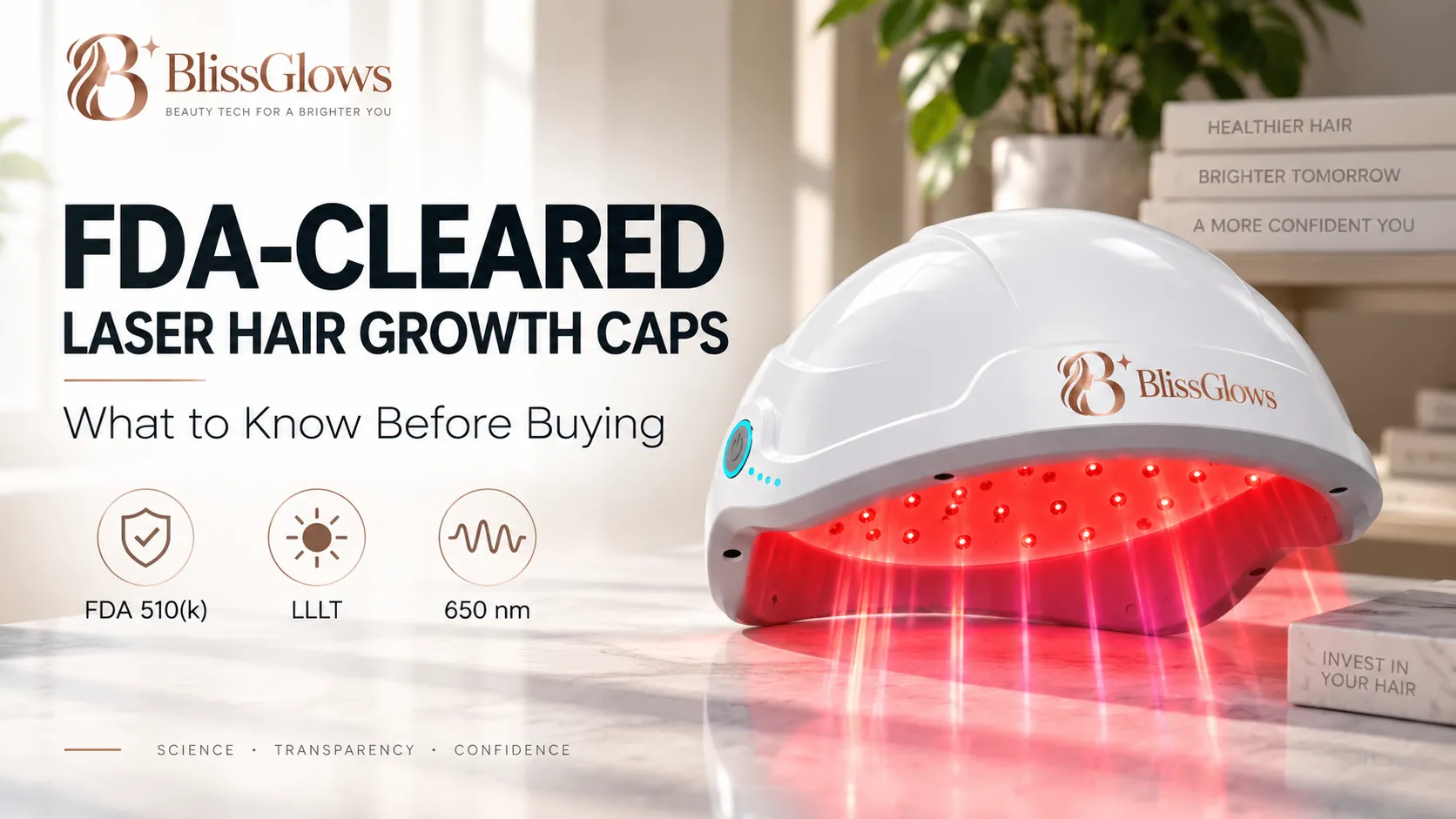
Laser hair growth caps have become a popular at-home option for people exploring low-level laser therapy (LLLT) for hair growth. But not all devices use the same technology, specifications, or regulatory pathway.
Before choosing a laser hair growth cap, it is important to understand factors such as FDA 510(k) clearance, laser wavelength, number of laser diodes, treatment protocol, and the difference between laser and LED technology.
This guide explains what these specifications mean, what to look for when comparing devices, and how to evaluate marketing claims before making a purchase.
What Is a Laser Hair Growth Cap?
What Is a Laser Hair Growth Cap?
A laser hair growth cap is a wearable device designed to deliver low-level laser therapy (LLLT) to the scalp. These devices use laser diodes positioned inside a cap or helmet to expose areas of the scalp to specific wavelengths of light.
Many at-home laser hair growth devices use red-light wavelengths, including 650 nm, although specifications such as wavelength, number of laser diodes, power output, treatment time, and regulatory status can vary significantly between products.
Laser hair growth caps are generally designed to be used regularly over a period of time rather than as a one-time treatment. For this reason, it is important to compare not only the appearance of different devices, but also their technical specifications, intended use, treatment protocol, and regulatory documentation.
Do Laser Hair Growth Caps Really Work?
Do Laser Hair Growth Caps Really Work?
Low-level laser therapy (LLLT) has been studied as a non-invasive approach to promoting hair growth in certain people with androgenetic alopecia, commonly known as male or female pattern hair loss.
However, results can vary between individuals, and not every laser hair growth device has the same specifications or regulatory status. Factors such as wavelength, laser output, number of laser diodes, treatment schedule, and consistent use can differ from one device to another.
It is also important to distinguish between general research on LLLT and evidence for a specific commercial device. An FDA 510(k)-cleared device should not automatically be described as “clinically proven” unless appropriate clinical evidence supports that specific claim.
For consumers, the best approach is to look beyond marketing claims and check the device’s documented specifications, intended use, regulatory information, and recommended treatment protocol.
What Does FDA 510(k) Cleared Mean?
What Does FDA 510(k) Cleared Mean?
In the United States, some hair growth devices are regulated by the U.S. Food and Drug Administration (FDA) as medical devices. A device that receives FDA 510(k) clearance has gone through a regulatory process in which the manufacturer demonstrates that the device is substantially equivalent to a legally marketed predicate device.
It is important to understand that FDA cleared and FDA approved do not mean the same thing. For many Class II medical devices, including certain laser hair growth devices, 510(k) cleared is the appropriate regulatory terminology.
FDA 510(k) clearance should also not automatically be interpreted as proof that every marketing claim made about a product has been clinically demonstrated. Consumers can look up a device’s 510(k) number, manufacturer, model, intended use, and regulatory classification to better understand what has actually been cleared.
When comparing hair growth devices, look for a specific FDA 510(k) number rather than relying only on phrases such as “FDA registered” or “FDA compliant.”
FDA Cleared vs FDA Approved: What’s the Difference?
FDA Cleared vs FDA Approved: What’s the Difference?
The terms “FDA cleared” and “FDA approved” are often used interchangeably online, but they describe different regulatory pathways.
For many Class II medical devices, the relevant pathway is FDA 510(k) clearance. Through this process, the manufacturer demonstrates that the device is substantially equivalent to a legally marketed predicate device for its intended use.
By contrast, FDA approval generally refers to different regulatory pathways and should not be used to describe a device simply because it has received 510(k) clearance.
This distinction is especially important when comparing laser hair growth devices. If a seller claims that a device is “FDA approved,” consumers should check the actual FDA record to determine whether the product is approved, cleared, registered, or simply manufactured by an FDA-registered establishment.
Why Does 650 nm Matter in Laser Hair Growth Devices?
Why Does 650 nm Matter in Laser Hair Growth Devices?
The wavelength is one of the key specifications to check when comparing laser hair growth devices. Many low-level laser therapy (LLLT) devices designed for hair growth use red-light wavelengths, including 650 nm.
A 650 nm laser emits visible red light. However, wavelength alone does not determine the performance of a hair growth device. Other factors — including laser power, number and distribution of laser diodes, treatment duration, treatment frequency, and total delivered dose — also matter when evaluating a device’s specifications.
This is why two devices that both advertise 650 nm laser technology should not automatically be considered equivalent. Consumers should examine the complete technical specifications and, when available, supporting regulatory documentation rather than relying on wavelength alone.
A higher number of lasers or a higher power specification does not automatically mean better hair-growth results. The complete treatment parameters should be considered together.
Laser vs LED Hair Growth Devices: What’s the Difference?
Laser vs LED Hair Growth Devices: What’s the Difference?
Laser and LED devices can both emit red light, but they are not the same technology. Laser diodes produce a more directional beam of light, while LEDs generally produce broader, more diffuse light.
When comparing at-home hair growth devices, consumers should therefore look beyond terms such as “red light therapy.” Check whether the device actually uses laser diodes, LEDs, or a combination of both, as well as the wavelength, output specifications, treatment protocol, and regulatory documentation.
Neither technology should be considered better based on the name alone. What matters is how the specific device is designed, documented, and intended to be used.
How Many Laser Diodes Should a Hair Growth Cap Have?
How Many Laser Diodes Should a Hair Growth Cap Have?
The number of laser diodes is an important specification to consider, but more lasers do not automatically mean better results.
A hair growth cap uses multiple laser diodes positioned across the device to deliver light to different areas of the scalp. The diode count can influence coverage, but it should be evaluated together with other specifications such as wavelength, power per diode, diode distribution, treatment duration, and recommended frequency of use.
For example, a device with a higher diode count should not automatically be considered more effective than one with fewer diodes. The overall design and documented treatment parameters matter more than a single specification.
When comparing devices, look for manufacturers that clearly disclose the number of laser diodes and their wavelength and output, rather than relying on vague claims such as “high power” or “advanced laser technology.”
Laser diode count • Wavelength • Power per diode • Treatment schedule • FDA regulatory information
Does Higher Laser Power Mean Better Hair Growth?
Does Higher Laser Power Mean Better Hair Growth?
Not necessarily. A higher power specification does not automatically mean better hair-growth results. When comparing low-level laser therapy (LLLT) devices, power is only one part of the overall treatment parameters.
Several specifications may be relevant, including power per laser diode, irradiance (mW/cm²), energy density (J/cm²), treatment duration, treatment frequency, and the area being treated.
Irradiance describes the amount of optical power delivered over a given area, while energy density also takes treatment time into account. This means that comparing devices based only on total power or the number of laser diodes can be misleading.
LLLT also should not be viewed as a simple “more power is better” technology. Consumers should consider the device’s complete documented treatment protocol rather than choosing a product solely because it advertises a higher output.
More power does not automatically mean better results. Compare wavelength, irradiance, dose, treatment time, coverage, and regulatory documentation together.
Who Are Laser Hair Growth Caps Intended For?
Who Are Laser Hair Growth Caps Intended For?
Laser hair growth caps are not necessarily intended for every type or cause of hair loss. Many FDA-cleared low-level laser therapy (LLLT) devices are intended for certain men and women with androgenetic alopecia, commonly known as male or female pattern hair loss.
The exact intended-use population can vary by device. Depending on the specific FDA clearance, this may include defined stages of male or female pattern hair loss and specific Fitzpatrick skin phototypes.
Hair loss can also have many other causes. Therefore, consumers should not assume that a laser hair growth device is intended to treat every form of hair loss simply because it is marketed as a “hair growth cap.”
Before purchasing an FDA-cleared device, check its specific 510(k) documentation and intended use to understand the population for which the device was cleared.
FDA clearance for one specific indication should not be interpreted as clearance for every possible cause of hair loss.
What Should You Check Before Buying a Laser Hair Growth Cap?
What Should You Check Before Buying a Laser Hair Growth Cap?
Before buying a laser hair growth cap, it is worth looking beyond product photos and marketing claims. Technical specifications and regulatory documentation can help you make a more informed comparison between devices.
Consider checking the following:
1. FDA regulatory status
Look for a specific FDA 510(k) clearance number when a product is advertised as FDA cleared. This allows you to verify the manufacturer, model, and cleared intended use.
2. Light source
Check whether the device uses laser diodes, LEDs, or a combination of both. “Red light therapy” alone does not tell you which technology is inside the device.
3. Wavelength
Look for a clearly stated wavelength, such as 650 nm, rather than vague descriptions of red-light technology.
4. Number of laser diodes
Diode count can help describe the device's design and coverage, but a higher number should not automatically be interpreted as better performance.
5. Output and dose information
When available, look for specifications such as power per diode, irradiance, energy density, and illuminated area, together with the conditions under which they were determined.
6. Treatment protocol
Check how long each session lasts, how frequently the device should be used, and the recommended treatment period.
7. Intended use
Verify which type of hair loss and which population the specific device is intended for rather than assuming it is suitable for every cause of hair loss.
8. Manufacturer transparency
Verify the 510(k) number • Check laser vs LED • Compare wavelength and diode count • Review treatment protocol • Look for documented specifications
A Documented Example: BlissGlows LaserRevive™ 82
A Documented Example: BlissGlows LaserRevive™ 82
The BlissGlows LaserRevive™ 82 is based on the HAT-01 laser cap manufactured by Hubei YJT Technology Co., Ltd. The HAT-01 has been cleared by the U.S. FDA through the 510(k) pathway under K232356.
According to the FDA 510(k) documentation, the HAT-01 uses 82 laser diodes at a 650 nm wavelength, with an output of 5 mW ±20% per laser diode. The device is classified as a Class II medical device in the United States under product code OAP.
The documented treatment protocol is 30 minutes per session, three times per week, with sessions spaced every other day. The cleared indication covers certain men and women with androgenetic alopecia, including males classified as Norwood-Hamilton IIa–V and females classified as Ludwig-Savin I–II, with Fitzpatrick Skin Types I–IV.
Additional Manufacturer-Provided Specifications
Additional Manufacturer-Provided Specifications
Hubei YJT has also provided additional technical specifications for the HAT-01:
Average irradiance: 1.18 mW/cm²
Illuminated area: 348 cm²
Energy density: 2.12 J/cm²
These figures are manufacturer-provided specifications and should be distinguished from the specifications explicitly reported in the FDA 510(k) summary.
FDA 510(k) K232356 refers to the HAT-01 manufactured by Hubei YJT Technology Co., Ltd. FDA 510(k) clearance should not be described as FDA approval or as proof that every marketing claim has been clinically demonstrated.
Frequently Asked Questions About Laser Hair Growth Caps
Frequently Asked Questions About Laser Hair Growth Caps
Are laser hair growth caps FDA approved?
Are laser hair growth caps FDA approved?
What wavelength is commonly used in laser hair growth caps?
What wavelength is commonly used in laser hair growth caps?
Is a laser hair growth cap the same as an LED hair growth device?
Is a laser hair growth cap the same as an LED hair growth device?
Does a higher number of laser diodes mean better results?
Does a higher number of laser diodes mean better results?
How often are laser hair growth caps used?
How often are laser hair growth caps used?
Who may be a candidate for an FDA-cleared laser hair growth device?
Who may be a candidate for an FDA-cleared laser hair growth device?
What should I look for when buying a laser hair growth cap?
What should I look for when buying a laser hair growth cap?
Making an Informed Choice
Making an Informed Choice
Choosing a laser hair growth cap involves more than comparing prices or counting laser diodes. Understanding the device’s wavelength, treatment protocol, intended use, technical specifications, and FDA regulatory status can help you make a more informed decision.
When a device is marketed as FDA cleared, look for the specific 510(k) number and verify what that clearance actually covers. It is also worth distinguishing documented regulatory information from manufacturer-provided specifications and broader marketing claims.
For consumers considering 650 nm low-level laser therapy (LLLT) for androgenetic alopecia, transparent documentation can make it easier to compare devices based on verifiable information rather than promotional claims alone.