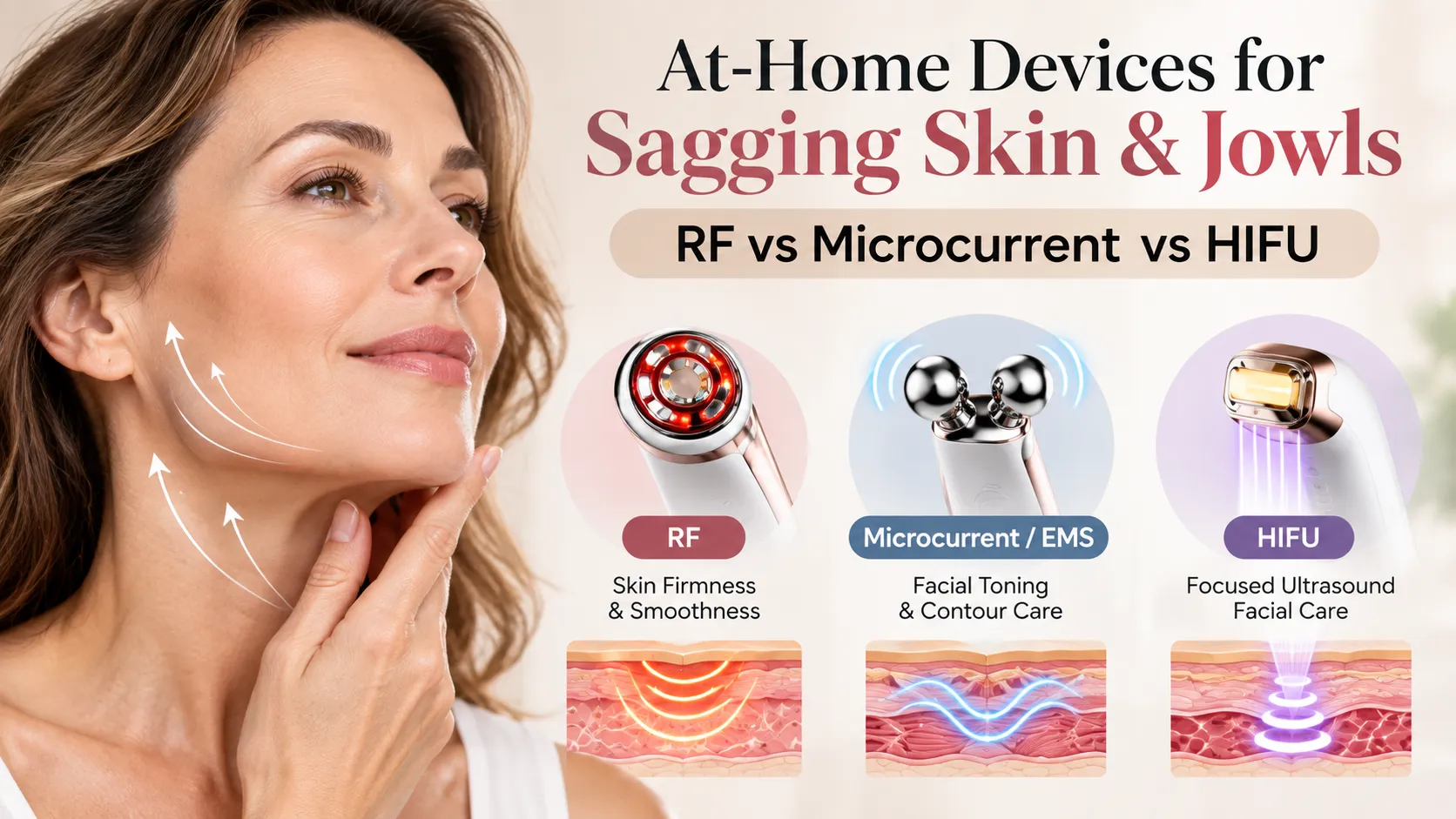
Best At-Home Device for Sagging Skin & Jowls: RF vs Microcurrent vs HIFU
If your jawline is starting to look less defined or you’re noticing the appearance of sagging skin around the lower face, you may be wondering whether an at-home beauty device can help — and which technology makes the most sense.
Radio frequency (RF), microcurrent and HIFU are three technologies commonly associated with at-home facial firming and contour-care routines. But they work differently, and the right choice depends on what you want to target.
In this guide, we’ll compare RF vs microcurrent vs HIFU for sagging skin and jowls, explain what each technology is designed to do, and help you understand what to look for when choosing an at-home skin firming device.
Quick Answer: Which At-Home Device Is Best for Sagging Skin and Jowls?
The best at-home device for sagging skin and jowls depends on your main concern. RF is commonly used in routines focused on firmer-looking skin, while microcurrent or EMS is commonly used for facial toning and contour-focused care. HIFU uses focused ultrasound and offers a different technology approach. If your goal includes both firmer-looking skin and a more defined-looking facial contour, a multi-technology device combining complementary modes may be worth considering rather than focusing on just one technology.
Why Do Jowls and Sagging Skin Appear?
As skin ages, changes in collagen, elastin, facial volume and underlying support can make the lower face look less firm or defined. These changes may become noticeable around the jawline, cheeks and neck, contributing to the appearance of sagging skin or jowls.
Genetics, sun exposure, lifestyle and the natural aging process can also influence how and when these changes become visible.
Can At-Home Devices Help With Jowls?
At-home facial devices cannot provide the same results as surgical procedures or professional in-office treatments. However, depending on the technology, they can be incorporated into a skincare routine focused on firmer-looking skin, facial toning and a more defined-looking facial contour.
The key is choosing the technology according to your main goal. RF, microcurrent and HIFU do not work in exactly the same way, which is why understanding their differences is important before choosing a device.
RF vs Microcurrent vs HIFU for Sagging Skin & Jowls
RF, microcurrent and HIFU are often discussed when people look for ways to improve the appearance of facial firmness and contour at home. However, each technology has a different role.
1. Radio Frequency (RF): For Firmer-Looking Skin
Radio frequency (RF) uses energy to produce controlled warming in the skin. In beauty devices, RF is commonly used in routines focused on improving the appearance of skin firmness and smoothness.
Consider RF if your main goal is:
- Firmer-looking skin
- Smoother-looking skin
- Lower-face and jawline care
- An at-home skin-firming routine
2. Microcurrent / EMS: For Facial Toning & Contour Care
Microcurrent and EMS are both electrical stimulation technologies used in facial-care devices, although they work differently. They are commonly incorporated into facial toning and contour-focused routines.
Consider microcurrent or EMS if your main goal is:
- Facial toning
- A more defined-looking facial contour
- Jawline-focused beauty care
- Adding electrical stimulation to your skincare routine
3. HIFU: Focused Ultrasound Technology
HIFU (High-Intensity Focused Ultrasound) uses focused ultrasound energy and takes a different approach from RF and electrical stimulation. Professional HIFU treatments and consumer at-home devices should not be considered equivalent, as professional systems may operate differently and at different energy levels.
For home users, HIFU may appeal to people looking for a technology-focused facial care routine alongside other firming and toning methods.
RF vs Microcurrent vs HIFU: Quick Comparison
| Technology | Common Beauty Goal | Often Considered For |
|---|---|---|
| RF | Skin firmness & smoothness | Sagging-looking skin, lower face & jawline care |
| Microcurrent / EMS | Facial toning & contour care | Jawline definition & facial toning routines |
| HIFU | Focused ultrasound facial care | Technology-focused firming routines |
Want a deeper explanation of how these technologies differ? Read our HIFU vs RF vs EMS Facial Devices Guide.
Which Technology Should You Choose?
The best choice depends on what you want to focus on in your skincare routine. Rather than choosing a device simply because it uses a popular technology, start with your main beauty goal.
If Your Main Concern Is Sagging-Looking Skin
If your priority is firmer-looking skin, RF may be particularly relevant because radio frequency is commonly used in skin-firming beauty routines.
If Your Main Concern Is Jowls or a Less-Defined Jawline
If you are mainly concerned about the appearance of your jawline or lower-face contour, microcurrent or EMS may be worth considering for facial toning, while RF can complement a routine focused on skin firmness.
If You Want More Than One Technology
You do not necessarily have to choose only one technology. Some at-home facial devices combine multiple modes, allowing you to incorporate different types of facial care into one routine.
This can be especially convenient if your goals include both firmer-looking skin and facial toning.
What About a Device That Combines HIFU, RF & EMS?
The BlissGlows UltraLift™ At-Home Skin Firming Device combines HIFU, RF, EMS and Pulse modes in one handheld device.
Rather than purchasing separate devices for different parts of your beauty routine, UltraLift is designed for people who want access to multiple facial-care technologies in a single at-home device.
It may be especially relevant if your beauty goals include:
- Firmer-looking skin
- Facial toning
- Jawline-focused skincare
- A more defined-looking facial contour
- Using RF, EMS and HIFU within one beauty routine
Frequently Asked Questions
What is the best at-home device for sagging skin?
There is no single technology that is best for everyone. If your main goal is firmer-looking skin, RF is commonly used in skin-firming beauty routines. Microcurrent or EMS is more commonly associated with facial toning and contour-focused care. Your choice should depend on your main skincare goal and the features of the device.
Is RF or microcurrent better for jowls?
RF and microcurrent have different roles. RF is commonly used in routines focused on skin firmness, while microcurrent is commonly used for facial toning and contour care. For someone concerned about both skin firmness and a less-defined-looking jawline, the two technologies may complement different parts of an at-home beauty routine.
Can microcurrent help with jawline definition?
Microcurrent devices are commonly used for facial toning and contour-focused beauty routines, including around the lower face and jawline. Results can vary, and at-home devices should not be expected to produce the same results as professional or surgical procedures.
Is HIFU or RF better for sagging skin?
HIFU and RF use different forms of energy. RF uses radiofrequency energy and is commonly associated with skin-firming routines, while HIFU uses focused ultrasound. The appropriate choice depends on the device, your goals and how the technology is intended to be used.
Can I use RF and microcurrent in the same skincare routine?
Some beauty devices combine RF with EMS or microcurrent-style electrical stimulation. However, how technologies should be combined depends on the specific device and its instructions. Always follow the manufacturer's recommended modes, frequency of use and safety guidance.
Can an at-home device get rid of jowls?
At-home beauty devices should not be expected to eliminate jowls or reproduce the results of a facelift or professional medical procedure. They are better considered as part of a consistent beauty routine focused on the appearance of skin firmness, facial toning and contour care.
Choosing an At-Home Device for Your Skin Goals
When comparing an at-home device for sagging skin or jowls, focus first on your main beauty goal. RF, microcurrent or EMS, and HIFU use different technologies and should not be treated as interchangeable.
If you want several facial-care technologies in one device, the BlissGlows UltraLift™ combines HIFU, RF, EMS and Pulse modes for a multi-technology at-home facial care routine.
For a more detailed technology comparison, see our HIFU vs RF vs EMS Facial Devices Guide.